
How to build a deck to code in Kentucky
A deck looks simple from the outside. Posts, beams, joists, decking. But the connections between those elements — and between the deck and the house — are where decks succeed or fail.
I've written separately about the things to consider before adding a deck to your home in Kentucky — including why attaching a ledger to brick veneer is a serious structural mistake that can lead to collapse. This post goes deeper on the technical side: the seven connections that the Kentucky Residential Building Code requires for a structurally sound deck.
Get these right and your deck will perform safely for decades. Get them wrong and you're looking at a structure that may pass a casual inspection but fail under the loads it was designed to carry.
In order to build a code compliant deck and ensure its structural safety, an essential set of key connections have to be implemented in order to maintain a continuous load path. When these key connections are made properly, loads are transferred throughout the deck’s frame and into the ground and/or the adjacent structure to which the deck is connected. The 7 connections listed below ensure against uplift and lateral displacement and are in accordance to the requirements established by the Kentucky Residential Building Code.
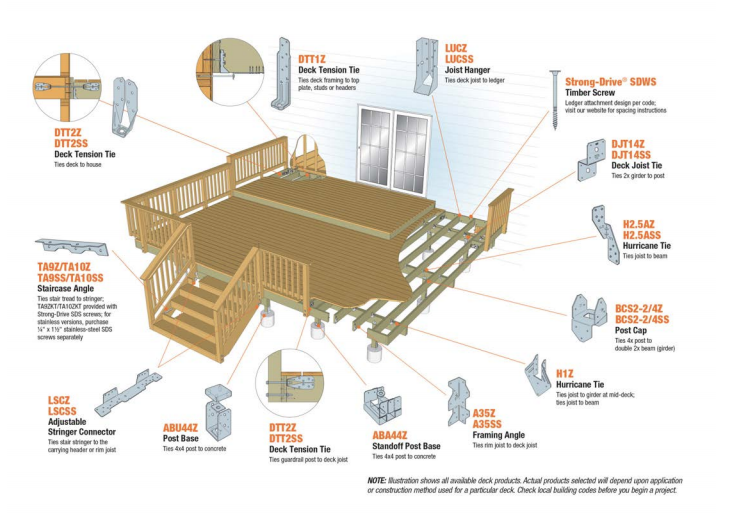
Simpson Strong Tie-Solutions offer a wide array of products that meet the Kentucky Residential Building Code
1. LEDGER-TO-WALL FRAMING
Correct ledger attachment is critical when a deck is attached to another structure. One of the most common causes for deck failures are ledgers that are not properly secured and pull away from the primary structure, resulting in collapse. The two most common ways to correctly attach the ledger to a structure are lag screws or machine-bolts through the ledger and into the rim joist of the supporting structure.
One important note: the ledger must be attached to structural framing — the rim joist or band joist behind the wall cladding. It cannot be attached to brick veneer, stucco, or siding. These are cladding systems, not structural elements. A ledger bolted to brick veneer transfers loads into a material that can't handle tension — and under load, the connection will eventually fail.
2. JOIST-TO-LEDGER
When deck joists terminate into a beam or ledger, a connection is required to provide bearing. For that you'd want to use joist hangers. In cantilever applications, the connection also must resist uplift. Ledger boards may not be installed over siding or stucco. It must be fastened directly to the rim joist or sheathing.
3. BEAM-TO-POST
At the point where a beam meets a post, it must be properly connected to the post in order to receive concentrated loads, lateral and uplift loads. This pertains to solid sawn beams or those comprised of multiple members, whether they rest on top or are fastened to the side of the post.
4. JOIST-TO-BEAM
At the point where the joist bears on top of a beam, there must be a connection to resist lateral and uplift forces. Blocking or framing also is required to prevent overturning of the joists.
5. RAILING POST-TO-DECK
The railing connection is another important connection pertaining to safety that is often overlooked. In order to provide the required load resistance at the hand rail, the post not only must be fastened to the rim joist, but also tied back into the joist framing. Post anchoring is essential. Machine bolts through the post and rim joist alone do not typically meet the performance requirements of the code. Instead, a mechanical connector installed into the joist with bolts through the post is needed.
6. STAIR TREAD-TO-STRINGER AND STAIR-STRINGER-TO-DECK
Stair stringers must be properly connected to the deck, and treads properly connected to the stringers, in order to resist loads. In addition, code requirements regarding openings between stair treads and stair railing must also be met.
7. POST-TO-CONCRETE
In order for posts to properly resist various types of loads, they must rest on and be anchored to concrete footings. Patios and pre-cast concrete piers do not qualify as proper footings for deck construction.
Posts must be correctly attached to a concrete footing in order to resist lateral and uplift loads. Unless posts are naturally decay-resistant or made from preservative-treated wood, aka pressure treated, they must be elevated off the concrete by 1 inch to help prevent decay at the end of the post due to moisture. Make sure that the footings are below the frost line.

In addition to building permit requirements, residential decks for 1 & 2 family dwellings and townhouses in Kentucky are also subject to zoning requirements. They are required to meet the land use and setback requirements of the zoning code. Consult with the local building department on different zoning ordinances if you're not sure about something.
If you're planning a deck in Lexington or Central Kentucky and need permit-ready drawings or a structural review of your approach, I can help. For more on the broader considerations — permits, zoning, historic overlays, and material choices — read my post on adding a deck to your home in Kentucky.
Need permit drawings for your deck in Kentucky?
I prepare construction documents that meet the Kentucky Residential Building Code and support the permitting process in Lexington and across Central Kentucky. The first conversation is always free.
Start a conversation